
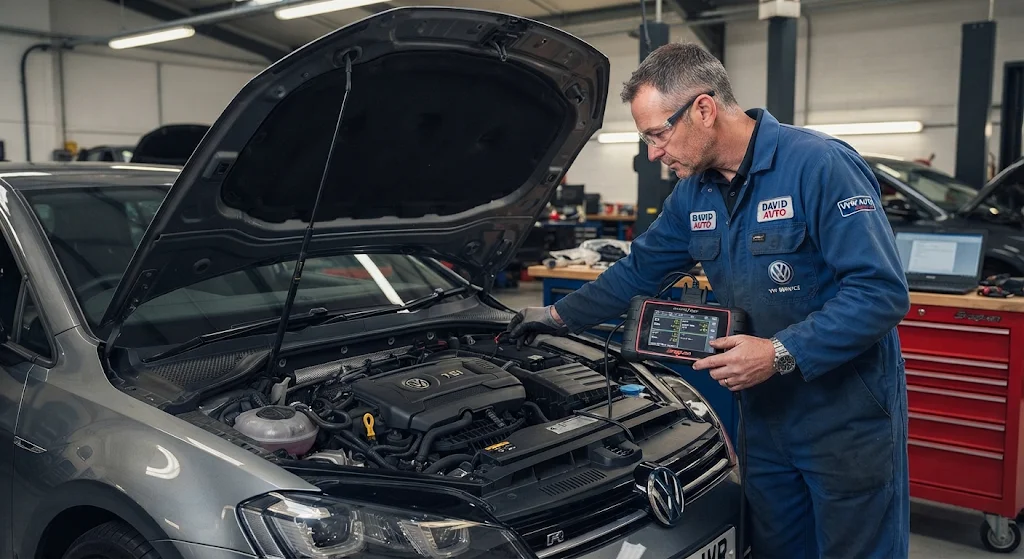
An OBD-II scanner can reveal information that is invisible during a walk-around inspection, from stored trouble codes to the status of emissions monitors. Yet a diagnostic readout is only one part of a vehicle inspection: understanding what the data shows—and what it cannot prove—helps inspectors make sound, consistent assessments.
OBD-II Scanners in a Vehicle Inspection
An OBD-II scanner connects to a vehicle’s onboard diagnostic system through its data link connector, commonly located beneath the dashboard. In a vehicle inspection, it can retrieve emissions-related information, identify reported faults, and show whether the system is ready for applicable emissions testing.
The scanner does not inspect brakes, tires, steering, body structure, or every electronic component. Nor does a code, by itself, establish the cause of a fault. It identifies a reported condition that may require further testing, so the result should be treated as evidence rather than a verdict.
Diagnostic Data and Inspection Findings
Different tools present different levels of detail. A basic fault code reader may display emissions-related trouble codes, while a more capable diagnostic tool can show live data, freeze-frame records, readiness status, and information from additional vehicle systems.
These features help explain when and how a problem was detected. For example, freeze-frame data may record engine conditions at the moment a fault occurred; live data can help a technician assess sensor readings while the engine is running. Interpretation still requires knowledge of the vehicle and the fault’s context.
| Tool or Data | What It Can Show | Inspection Consideration |
|---|---|---|
| Fault code reader | Stored or pending trouble codes | A code points to a system or condition, not necessarily a failed part. |
| Readiness monitors | Whether emissions self-checks have completed | Incomplete monitors may affect inspection eligibility, depending on local rules. |
| Live data | Current readings from supported sensors | Values need comparison with service information and operating conditions. |
| Advanced scan tool | Broader module and system information | Coverage varies by vehicle, tool, and software. |
Reading these results together is more informative than focusing on a single warning or number. The key is to connect electronic evidence with the inspection’s scope.
Emissions Testing and the Check Engine Light
A check engine light commonly signals that the engine or emissions-control system has detected a condition worth investigating. During an inspection, the light’s status and the scanner’s results may both matter, but acceptance criteria differ among jurisdictions and inspection programs.
Readiness monitors assess whether particular onboard checks have run. If a vehicle’s battery has been disconnected or codes have recently been cleared, some monitors may be incomplete until the required driving conditions occur. Clearing codes to hide a fault does not repair the underlying issue and may leave the vehicle unready for emissions testing.
Before drawing a conclusion, inspectors can use a consistent sequence of checks:
- Confirm the vehicle identification and connect the scan tool using the proper procedure.
- Record stored and pending trouble codes before changing or clearing anything.
- Review readiness status and note any incomplete monitors.
- Compare relevant live data and warning-light status with the inspection criteria.
- Document findings and recommend further diagnosis when the evidence is inconclusive.
Limits of Scan Tool Results
Automotive diagnostics can narrow the search for a fault, but an OBD-II system cannot detect every mechanical defect. A worn tire, damaged suspension component, fluid leak, or structural concern may leave no diagnostic code at all. Conversely, a code may reflect wiring, a connector, or an operating condition rather than a defective component.
Tools also differ in coverage. A generic scanner may access standardized powertrain data but lack manufacturer-specific functions or access to other modules. For a complex fault, a technician may need service documentation, electrical testing, a road test, or a more capable scan tool.
Inspection Practices for Reliable Results
Reliable automotive diagnostics depend on careful procedure as much as equipment. The scanner should be compatible with the vehicle, and the inspection record should distinguish observed facts from interpretations. Local rules determine which codes, warning lights, and monitor statuses affect the outcome.
A scan is most useful when it supports—not replaces—a broader assessment. Pairing electronic results with visual and mechanical checks gives inspectors a clearer basis for identifying concerns and deciding when specialized diagnosis is needed.

